


Thule Urban Glide 3, Two Years In: Did It Keep Me Running?

Updated: 3 days ago

The first run we ever did with the buggy was the morning of my brother's wedding. We went out really early, pushing it up the hill near our house. Hard work. Cold. But then the flat came, and watching our daughter's little feet bounce along, one of us running up alongside to say hi and getting a smile back, built something lovely before a big family day.
That was two years ago. When I reviewed the Thule Urban Glide 3 nine months in, the question everyone asks about a running buggy was the wrong one. It was never whether it rolled well. It rolls beautifully. The real question was whether we'd actually still be running with it two years later.
Here's the honest answer. (I bought the buggy myself, for what it's worth. Nobody sent me this one.)
What actually happened
Over two years, the buggy has gradually migrated from inside the house to outside it. That single sentence tells you most of the story.
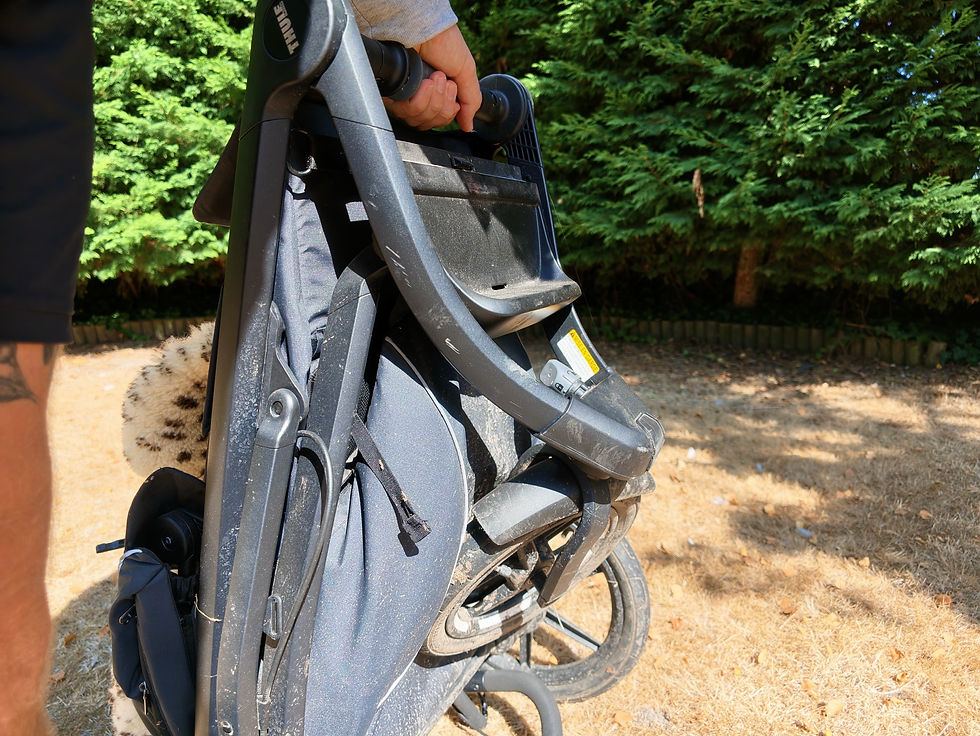
It worked really nicely whenever we wanted to run. The massive advantage is that it's big, stable and sturdy. But when you own something big, stable and sturdy, it's still big even when it packs down. That was our constant problem, and I flagged it in the original review. If anything, I undersold it.
For the first six months we had the bassinet attachment, which turned the thing into a tower, and you can't run with a baby that young anyway. Selling the bassinet at six months was a genuine relief. It did not make the buggy any smaller.
Then, at nine months, our first family holiday. We bought a small travel buggy for it and it was the best thing we did. I could not imagine lugging the Thule through an airport or around foreign towns. So the running buggy became exactly that. A running buggy, plus the occasional long walk. And now, at nearly two, our daughter wants to walk everywhere and doesn't enjoy sitting for long. We're hoping that changes as she gets older and can chat, look around or entertain herself on the move. We're not there yet.
The kit, two years in
Tyres. The annoying one. I've replaced inner tubes multiple times. Maybe it's our roads, maybe it's us, but we've had real bad luck here. Thankfully it's an easy job.
Folding mechanism. Perfect. Genuinely can't complain.
Brakes. Squeaked a lot early on. We sent it back, they tested it, found nothing, returned it. It still squeaks now and again. My fix: squeeze the brakes hard, then move the buggy, and it seems to unstick them.
Fabric and seat. Really good. We added a sheepskin liner and it's been great.
Storage. The basket underneath is mucky and well used, which is exactly what you want. Still holding strong.
What I got wrong in the original review
In my first review I told you to lock the front wheel for running so you're not "going all over the place". I'm taking that one back.
I found it almost impossible to lock the wheel so it pointed dead straight. For months we'd stop three, four, five times a run because the buggy was veering off with the wheel locked. So I stopped locking it, and I've had no problems since. Steering is easier too.
Now, a caveat. Thule tells you to lock the swivel wheel at speed, and there's a good stability reason for that. So this is what I actually do, not what I'm telling you to do, and I'll admit it still slightly concerns me. But two years of honest use is two years of honest use.
What running with a buggy is actually like
We run around 9 minutes a mile with it, and that feels really comfortable. I have never once attempted an interval session with the buggy, and I don't intend to. The speed changes would be incredibly frustrating, and keeping at least one hand on the handlebar changes your running style so much that it just doesn't feel pleasant at pace. Run to effort, not pace, applies double here. Your buggy pace is not your pace, and that's fine.
What I love is the space. Everything goes in the buggy, which would make it brilliant for longer runs, as long as your passenger agrees to the itinerary.
Routes are the biggest limitation, and nobody tells you this before you buy. The buggy is too wide for many of our local pavements, so it's either the cycle lane, which is awful, or a small set of approved routes. Anything beyond a proper footpath is out. We have a lovely route near us over the fields and along the Thames path, and it is simply not possible with the buggy in any way, shape or form. In a few years she'll be cycling and we'll get there together. But then, you have to ask, why do you still have the buggy?
And the best bit, which no spec sheet mentions: put some music on. Our daughter has developed a taste for punk rock and dance music, and she'll sing and dance along in the seat while we run. Two years ago I was the one singing to her. Now she sings back.
Did it keep me running?
I run a bit these days, nowhere near as much as I used to. I train in the gym, I keep things varied, and I could see how I could make some form of training work with the buggy, but certainly not at the level I used to run at. So the buggy was never rescuing a marathon habit.
What it did was make family running possible. No childcare, no admin, no negotiation. All three of us out the door together. The buggy had zero impact on my ability to run. It made it very possible and very realistic. Whether I ran was always about me, not the kit.
And here's the coaching truth I'd give a client, so I'll give it to myself too. The buggy works if buggy running becomes a habit. Children are wonderfully honest about this: if you don't do something regularly, they don't get used to it, and every outing becomes a negotiation. Little and often beats the occasional heroic effort. A fixed family run slot each week would have served us better than waiting for the mood to strike. There could, let's say, have been some more training happening around that.
The verdict, and the true cost
Would I buy it again at full price? I'm honestly not sure. All in, with the bassinet and accessories, we spent around £1,000, though we sold the bassinet on for only £50 less than we paid, which softens the blow. Add the travel buggy we bought because the Thule is too big for normal life, and this becomes an expensive way to run. We're lucky to have been able to do it, I'm really glad we have it, but I think we could have managed without it and trained differently.
If you're a committed runner who'll be out with it three or four times a week, it's superb and I'd say go for it. If you're like us, running now and again as a family, borrow one, buy secondhand, or at least go in with your eyes open about the size and the routes.
If you're where I was
If you're a new parent lying awake wondering whether you're still a runner, I wouldn't even entertain the question. You are. You always were. The miles you're not doing right now don't cancel the ones you did, and they don't cancel the ones coming.
The buggy, or no buggy, is just logistics. The runner is still there. And one cold morning, maybe before a wedding, you'll push a small person up a hill and hear them laugh on the way back down, and you'll know it.
Related reading: Is the Thule Urban Glide 3 Worth It? A Parent's Honest Review
Coming back to running?
A new baby, an injury, a few years where life simply got in the way. Getting back out the door is rarely just about your legs. It's the quieter question of whether you still count as a runner.
Want more from us Join the monthly email →
