


Oura Ring 4 Ceramic Review: Why I'm Not Upgrading to the Ring 5

Introduction
The Oura Ring 5 has just landed, and it's the smallest, sleekest one yet. So naturally, here I am writing about the Oura Ring 4 Ceramic — the model it replaces. Hear me out, because there's method in this.
The arrival of a new model is the best possible time to talk about the old one. Prices of these older models often reduce, and the case for upgrading gets murkier than the marketing would have you believe. If you already own a Ring 4 you might be wondering whether you've just been left behind. Short version: you haven't. I've been living with the Ring 4 Ceramic — two of them, actually — and I'm not rushing out for the 5. Here's the honest, runner-and-coach's-eye view of why.
Quick Specs
Price: £499 (Ceramic) / standard Oura Ring 4 from £349
Material: High-performance zirconia ceramic outer (colour baked into the material, not a coating)
Colours: Midnight, Tide, Cloud, Petal
Sizes: 4–15
Battery Life: 5–8 days
Water Resistance: Water resistant
Membership: Requires Oura Membership (~£70/year) for full app features
Key Features:
Sleep tracking, Readiness, and Stress/recovery scores
24/7 heart rate and HRV
Temperature-based illness early warning
Multi-ring support (switch between rings on one account)
Optional Charging Case (£99)
A quick bit of housekeeping first: I bought both of my rings myself, and I pay for the Oura Membership out of my own pocket. This isn't a freebie review. That matters, because one of my biggest gripes is the cost, and I want to be upfront that I've actually felt that cost in my own bank account.

First Impressions & Design
Let's start with the thing that makes the Ceramic special: it's made from zirconia ceramic rather than titanium. The headline benefit is durability and scratch resistance, and the lovely side effect is colour — proper, rich colour that's part of the material itself rather than a coating that can wear off.
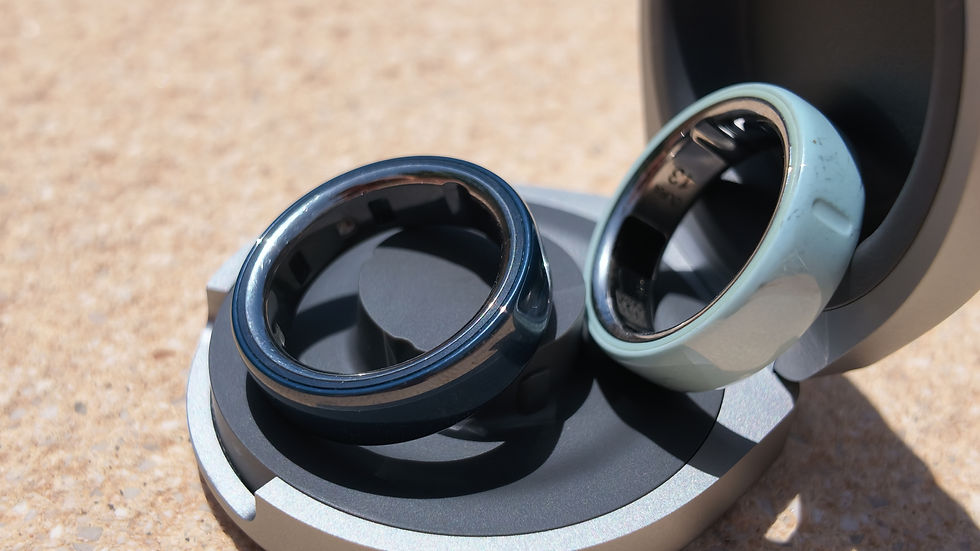
I have two: the Midnight (a deep, dynamic blue) and the Tide (a light aqua-green — I had to look the official name up, I'd just been calling it "the green one"). Do I need two? Absolutely not. But having the colour options to match my mood or what I'm wearing is genuinely lovely, and Oura's multi-ring support means I can switch between them on one account without losing any data.
Here's a real-world durability note, though. The dark Midnight wears beautifully — it's shrugged off everything. The lighter Tide picks up marks far more easily. The supplied cleaning cloth does a great job of buffing them away, but you do have to actually use it. So if you're tempted by one of the paler colours, just know you'll be giving it the occasional clean.
The Fit Test (Or: Does a Ring You Wear Forever Disappear?)
I have big hands and I'm wearing a size 13. The honest truth about wearing a smart ring all day, every day is this: after a few days, you stop noticing it entirely. It was exactly the same when I first put my wedding ring on — alien for a week, then part of you. The only time I'm aware of the Oura at all is when it's really hot and my hands swell a touch.
I usually wear it on my index finger, but it works perfectly well on the middle finger too, where it sits a little more gently. The data quality is excellent either way.
For running and spinning, you genuinely don't notice it on your hand. It can move around a little, but I've found the data holds up brilliantly regardless. The only time it comes off is for Body Pump and lifting weights — the grip on a barbell makes it too noticeable, and I take all my rings off for that anyway. The clever bit: those sessions get tracked on my Apple Watch, and because that data syncs through to Oura, the ring being off my finger doesn't leave a hole in my numbers.
What I Actually Use It For
This is where it earns its place. For me the Oura is a sleep, readiness, and early-warning device — and its sleep tracking is miles ahead of the Apple Watch in terms of genuinely useful data. That's its killer feature.
I check my sleep number, but I try hard not to get obsessed with it. This is the same principle I bang on about with training: a number is PART of the picture, not the whole truth. Just because the ring tells me I'm rested doesn't always mean I am — and vice versa. The data informs my judgement; it doesn't replace it.
The other feature I really love is stress accumulation. Seeing how stressful a day has been — not just from training, but from everything else life throws at you — is genuinely illuminating. It tells you something about how you're actually doing that's easy to miss when you're in the thick of it.
Does It Change My Training? (A Bit — And That's The Right Amount)
This is the question I always come back to with recovery tech, so let me be clear: the Oura influences my training decisions, but only a little. It is not my north star. I'm still trusting my own judgement first.
Where it's genuinely useful is confidence. If I feel a bit flat but the ring shows I've recovered well, that can be the nudge to crack on with a session I might otherwise have talked myself out of. For weights, I'll use it to loosely guide how much I might want to lift on a given day — but I still let the session happen and listen to my body in the moment. And seeing what a proper rest day looks like in the data is genuinely reassuring. It's a co-pilot, not the pilot. That, for me, is exactly how this kind of tech should be used.
The Charging Case
I bought the charging case too, and for travel it's brilliant — having charge available wherever you are, with no faff, is a real quality-of-life upgrade. But my goodness, it all adds up. Which brings me neatly to my biggest gripe.
The Catch: Cost
The expense is genuinely annoying. You buy the ring, and then you pay for the app features on top — that subscription stings every time I think about it. Add the charging case and you're a long way past the quoted retail price. If money is tight, go in with your eyes open: this is an expensive habit, not a one-off purchase.
To Oura's credit, there's a robust API, so you can pull your own data out rather than living inside their app. I've set up a little daily message that grabs my sleep and readiness and tells me about them — I'd far rather read a quick summary than open the app and risk falling down a rabbit hole of constant checking. I want to be OFF my phone more, not glued to it. (One honest caveat: I'm not certain the API access works without a paid membership — the ring has limited functionality without it — so if data freedom is your reason for buying, check that first.) The one snag with my setup is you do still have to open the app to sync the data, which is a small but real bit of friction.
Why I'm Not Upgrading to the Ring 5
Now, the elephant in the room. The Ring 5 is out, it's about 40% smaller, and I am a complete sucker for new and shiny gadgets. Holding off has genuinely tested my willpower. But I'm doing well, and here's the rational case I keep reminding myself of:
You can only wear one of these at a time. If I bought the 5, my current charging case and accessories would all need replacing or selling on. Yes, I could shift the old gear on eBay and claw some money back, but the cost of entry to the new model is frustratingly high once you total it all up.
The Ring 4 Ceramic works great. The size is good — it slips on and is barely noticeable (a touch more noticeable than my other rings, but not by much). Could I appreciate something smaller? Honestly, yes — there's a bit of a fashion statement to these now, and I don't mind admitting I'm drawn to that. But "smaller and a bit nicer to look at" is a long way from "worth several hundred pounds to replace a ring I'm perfectly happy with."
And here's the clincher, the thing that genuinely impressed me about Oura: they're bringing the Ring 5's new software features back down to the Ring 4 and even the Gen 3. So a lot of what makes the 5 exciting will land on my existing ring anyway. If you already own a Ring 4, I struggle to see a compelling reason to buy the 5. Hats off to Oura for not abandoning older owners — it's the opposite of how a lot of tech companies behave.
If you have smaller hands you’ll probably really notice and enjoy the reduced size of the newer ring.
Is the Ceramic Worth It Over the Standard Ring?
Let me be honest: the ceramic is very much a nice-to-have. You could survive perfectly well without it. I went for it for two reasons — the more durable nature, and because it simply looks way cooler in colour. My reasoning was that if I'm going to wear another ring all day, every day, I absolutely want it to look good. I'll even admit I still get a little twitchy about scratching it- I absolutely have to take it off when doing the washing up, which I promise I do do now and again). I am not sure I worry less than I would with titanium, but I appreciate the sturdiness.
A tip if you're deciding: get the sizing kit and live with it for a few days first. I did, and it let me be confident that both the fit was right and that having a ring on my finger was going to look good before I committed real money.
Alternatives to Consider
The obvious one is the standard Oura Ring 4 (from £349) — same technology, same data, titanium instead of ceramic. If you don't care about the colour or the extra scratch resistance, you save a meaningful chunk of money. The Oura Ring 5 (from £399) is the choice if you're brand new to Oura and want the smallest, latest design from the off — but as above, it's a much harder sell as an upgrade. And if a wrist wearable suits you better, a good running watch or the Apple Watch covers a lot of ground — though for pure sleep and recovery data, I still rate the Oura above the Watch.
On that note: I've worn a Whoop band in years gone by and found wearing yet another thing on my wrist genuinely annoying. Part of me wants to experiment with going ring-only and ditching the Apple Watch entirely — Oura can even help close the Apple exercise and move rings — but I'm over 2,000 days into an Apple Watch move streak and I'm not quite ready to let my little rings stop closing. The ring can't do a standing ring, so for now I'll keep wearing both. Old habits.
Final Verdict
You can absolutely survive without an Oura Ring. Nobody needs one. But for a bit of extra data, and for something that genuinely crosses over between my running and the rest of my life, I really value it. The sleep tracking alone has earned its keep, the stress and readiness data is a useful co-pilot, and the ceramic finish means I actually enjoy wearing it.
My recommendation: If you already own a Ring 4, do not feel any pressure to upgrade to the 5 — the new features are coming to you anyway, and your ring is still excellent. If you're new to Oura and the budget stretches, the Ring 4 Ceramic is a lovely thing to own and the colours are a real treat — just be honest with yourself about the ongoing membership cost before you commit. And if you want the same brilliant data for less, the standard Ring 4 does everything the Ceramic does, minus the looks.
Just go in knowing what it is: a genuinely useful piece of the picture, not the whole picture. Same as ever.
Got a question about training with recovery data, or want help making sense of your own numbers? Drop me a line — I coach runners through exactly this kind of thing.


