


Marathon Training Nutrition: Fuelling for the Long Run
- Feb 25
- 7 min read

We are not nutritionists. Let's get that out of the way first.
We are running coaches with an obvious interest in, and understanding of, nutrition — but we are not qualified dieticians or nutritionists in any way, shape or form. What we are is coaches who have worked with thousands of runners navigating the exact same questions you're probably asking right now. So this post is built on experience, common sense, and what we've seen work in the real world.
Fuelling Up vs. Losing Weight
Perhaps one of the saddest realisations you come to during marathon training is that it isn't that great for weight loss. Especially marathon training.
The reason is simple: you have a choice between losing weight and fuelling up for the training sessions you've got coming. Our preference will always be to fuel up so that you can train well, rather than living on a calorie-restricted diet and then struggling to finish sessions. You're going to get more confidence from finishing sessions strong than you are from losing a couple of kilogrammes.
This isn't to say that losing a bit of weight while running is impossible. It's very likely there will be a shift in body composition — but that doesn't necessarily mean lower numbers on the scales. Muscle is denser than fat, and endurance training changes what your body is made of, not just how much of it there is.
Match Your Food to Your Training
Your training will have harder days and easier days. Your food intake wants to match this as closely as possible.
When you've got a big session coming up, you need to fuel up beforehand to give you the energy for the session, and afterwards to help the recovery process. On harder training days, you'll need more. On easier days, there's a bit more flexibility.
Got a big threshold session or a long run tomorrow? Porridge, pasta, rice — the works. Rest day? You can ease off and keep things lighter. It doesn't need to be complicated. Think of it like this: your food is part of the training, not separate from it. Match the fuel to the work.
The Long Run Isn't an Excuse to Pig Out
One of the other issues that emerges with endurance training is that you feel like you could eat anything. And you're probably hungry enough to eat anything. But that can lead to some really poor choices in the big scheme of things.
This isn't to say you shouldn't treat yourself — especially after a big training session, it's really nice to reward yourself with something sweet or something flaky. But just be careful.
Getting in protein is going to help fill you up, and so are fibre-rich vegetables. Having some really nice snacks around to satiate the hunger is incredibly useful:
Fruit
Nuts and seeds
Yoghurt
Brilliant choices. Really portable. And you can absolutely have them without overthinking it.
Do I Have to Stop Drinking?
This is a really common question, and the honest answer is: no, you don't have to.
We know that alcohol slows down the recovery process, which can negate some of the training gains you're making. You're not going to sleep as well, and it can leave you dehydrated, amongst other things.
That said, going completely teetotal can put a lot of pressure on your race. You're giving up alcohol for the race, and that adds another layer of complexity and psychological weight to the whole endeavour. Sometimes, that's just too much.
There is nothing wrong with a glass of wine, a beer, or — if you're anything like me — a delicious fruity cocktail.It's about moderation and timing. You don't want to be doing a long run hungover. You don't really want to be doing any big training session hungover. But you could always take that as a rest day and replan your week accordingly.
Everyone is different. It might work for some people, it might not for others. But going teetotal is not a necessity.
So that's the day-to-day stuff sorted. But what about when you're actually out there running? That's where things get interesting.
On-the-Run Nutrition: What's the Story?
Our bodies contain roughly 90 minutes' worth of glycogen storage. That is not enough to last for the marathon. You won't be burning through 100% of your glycogen in one go, so it will last a bit longer than 90 minutes — but it isn't going to last the full distance. There are arguments to suggest it won't comfortably last a half marathon either, depending on you.
Now, here's the key bit that a lot of runners get wrong. Taking on nutrition during your marathon slows the rate at which you burn through your glycogen stores. It doesn't give you energy. People sometimes expect some magical response from taking a gel, and it really doesn't work like that. What it does is preserve what you've already got for longer.
Grams, Grams, Grams
We've never enjoyed weighing food, measuring grams and getting lost in a world that feels so fiddly and faffy. And here's the thing — any gel company is going to want you to use multiple gels an hour. If you're buying two gels an hour rather than one, you've doubled their sales. That's good for them.
A lot of the studies around carbohydrate intake are done in a lab, not outside in the real world. They're often done on elite athletes too, who have very different metabolisms and energy needs compared to us everyday folk. The research says that for exercise over 3 hours, you could look at getting up to 90g per hour of carbohydrates, and that needs to come as a mix of glucose and fructose in a 2:1 ratio. But that's the top end — and if you're in the 5-hour marathon range, running at a lower intensity, you'd want to bring that number down.
Our thinking: a gel every 45 minutes from the start of your run. That's a really nice baseline to work from. You could have them a little sooner or a little more frequently, but that works well for most people.
Hydration and Electrolytes
When we sweat, we don't just lose water — we lose electrolytes too. In day-to-day life, we maintain a nice balance of water to electrolytes and top them up through the food we eat. But when you're running, especially in warmer conditions, that balance shifts.
If you've ever come home from a run with white residue around your face or on your clothing, that's your electrolytes.
The issue is this: if you just drink water on a run, you're diluting the ratio of water to electrolytes even further. That's where an electrolyte tablet or a gel with electrolytes in it comes in handy — it boosts your stores back up and helps get things back in balance.
You'd likely only need one, maybe two, throughout a marathon. They're very light, easy to carry, and well worth practising with — especially if you're quite a salty sweater.
The Curious Case of Caffeine
Caffeine is an incredible stimulant — if it doesn't move through you so quickly that it requires a detour to the nearest bush.
Caffeine has been shown to help the absorption of carbohydrates and reduce the perception of discomfort. It also perks you up and gets you out of that long-run brain fog — where things feel that much harder and you can't quite think as clearly.
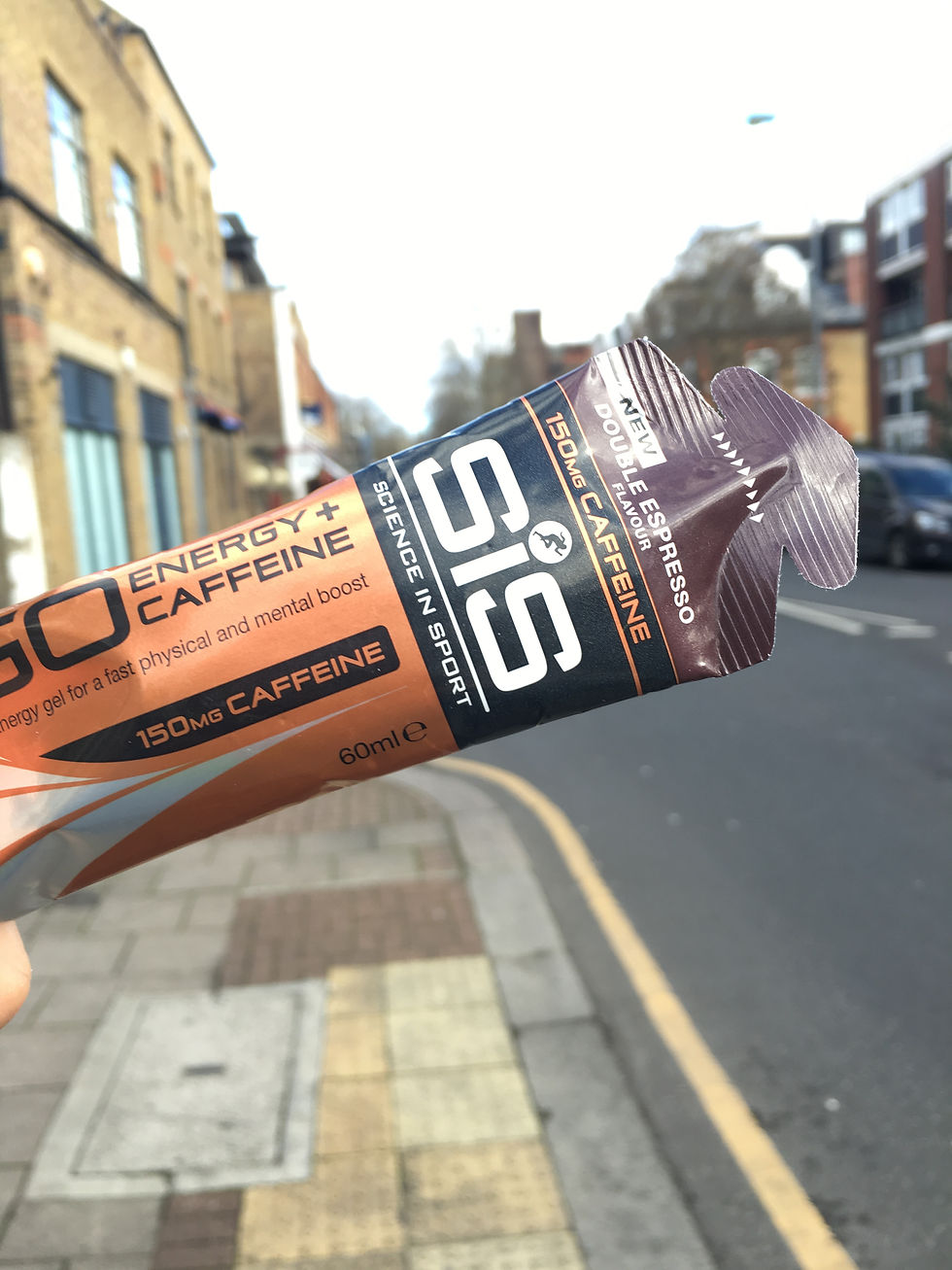
You can buy caffeinated gels, and later on in a run, they can be fantastic. We'd really recommend experimenting with them in training to see if they work for you. If they do, you can build them into your race day routine — saving them for the second half when you need that lift most.
Choosing What Works for You
There is an extraordinarily large number of fuelling options out there — different flavours, textures, carbohydrate levels, electrolytes, caffeine, and everything else. We can't tell you which gel or product is best, because it really doesn't make sense to. We're all so different, with different tastes, texture preferences, and stomachs.
Our biggest advice: try a load of different ones and find a brand — or a selection — that works for you. You might find one gel and stick to it. Or you might end up rotating between a few different brands. Either is fine.
A few rules we'd strongly suggest:
Start early. They don't work if you leave it too late.
Mix up the flavours. That same tropical gel three hours into a marathon does not taste as good as it did the first time around. Give yourself something different later on.
Practice in training. Never try anything new on race day.
Gels don't agree with everyone. The first time you have one, it might be horrible. It's really worth persisting, because part of the process is training your gut to absorb and get used to them.
But if gels really aren't for you, there are plenty of alternatives:
Clif Shot Bloks — jelly-like cubes; three is the equivalent of a gel
Dried fruit — we say dried because fresh fruit on a run gets mushy. Say no more.
Sports bars or natural fruit bars — like the Nakd ones
Carbohydrate-based drinks — pop a carb powder into your drink bottle
Homemade rice cakes — like the cyclists have
You've just got to think about how you're carrying them and whether you can digest them. It really doesn't matter what it is. It's just about getting it in.
We wouldn't be bothered at all if you were having a jam sandwich on a run. Fantastic. Take it. Do it. Whatever gets some fuel into your system.
Don't Carry It All Around
One of the saddest sights to see as a running coach is somebody coming into the final straight of their marathon with a belt full of gels. You've just carried them around the whole course and given them a free lift. They haven't done anything for you.
Either you've overpacked — which we can kind of forgive, but not by much, because you should have a sense of how many you'll need — or you've just not taken them. And if that's the case, it's such a waste, because you haven't given yourself the best opportunity to run well.
We know it can be hard to get them down. It really is tough at times. But you've just got to do it. Open the gel, get it in. Some people like to sip them over a longer period. Others just want to get them down and away. There's no right or wrong — just do whatever works for you.
Some brands are even releasing gels with screw tops now, so you can sip one gel over the equivalent time of two or three. That might suit you better.
Pack what you need, maybe one extra for an emergency boost later on, and use them all.
Looking for help dialling in your nutrition alongside your training? Nutrition guidance is part of every Full Potential coaching plan. Get in touch to find out how we can help you run to your full potential.

Comments