The Marathon Race Day Checklist: Kit, Fuel, Mindset, Done


You've done the training. The long runs, the threshold sessions, the early mornings and the sore legs. You've tested your gels, broken in your shoes and earned every mile. Now it's time to make sure you don't undo all of that by forgetting your race number on the kitchen table.
Race day preparation is one of the most underrated parts of marathon training. It doesn't get the same attention as speed endurance or nutrition strategy, but getting it wrong can ruin your day before you've even crossed the start line. And the thing is, most of it is completely avoidable — if you've got a plan.
This is your race day checklist. Everything you need to think about from the week before to the moment you step onto that start line. Kit, nutrition, logistics, mental preparation — all of it.
Race Week: The Groundwork
Race week is not the time to prove anything. Your fitness is banked. The hay is in the barn. What matters now is arriving at that start line healthy, rested and confident.
Collect your race number early. If there's an expo, go early in the week when it's quieter. This is important — you do not want to spend hours on your feet the day before running 26.2 miles walking around an expo. Get in, collect your number, say hello to your charity stand if you have one, and get out. Anything you buy at the expo is for after the marathon. Nothing new on race day.
Eat a bit more, but don't overdo it. A common mistake is to stuff yourself with mountains of pasta on Saturday night. You don't need to. Graze on a little extra carbohydrate throughout the week — half a bagel as an afternoon snack, a bit more rice at dinner. The reduction in your training volume means your body will absorb and store that energy naturally. Have a slightly bigger lunch on Saturday and a sensible dinner with a bit more carbohydrate than usual. You should not be going to bed so full that you can't fall asleep.
Lay out your kit on Saturday night. Everything you're wearing, everything you're carrying. Lay it all out and take a photo. It settles the mind, makes sure you haven't forgotten anything, and doubles as a great final fundraising push on social media. A huge number of donations come in over race weekend — make the most of it.
Set multiple alarms. Phone, watch, a backup call from someone you trust. Oversleeping on the biggest running day of your life is not something you want to experience.
Race Day Kit: Tested and Trusted
Your race day kit should feel like a second skin. Every single item should have been worn, eaten or used in training. If it hasn't, it stays at home.
All of these items are built into the interactive checklist in the Full Potential app, so you can tick them off as you pack.
The Essentials
Running shoes — the pair you've been training in. They should be the most comfortable shoes you own. If you bought a new pair recently, you should have had at least a few weeks of running in them. There's a higher injury risk in the first couple of sessions in new shoes, so breaking them in properly is essential.
Race day outfit — top, shorts or tights, socks. All tested on long runs. You know how they feel, you know nothing rubs, you know they work.
Race number and timing chip — pin your number to your top the night before. One less thing to think about on race morning. Some races use a separate timing chip that attaches to your shoe, so check your race information ahead of time.
Running watch and phone — fully charged the night before. Your watch is your tracking guide on the day. Your phone is your lifeline for logistics and meeting supporters afterwards.
The Details That Matter
Good socks. They matter more than you think. A moisture-wicking running sock keeps your feet cool and reduces rubbing. If you're prone to blisters, consider toe socks — brands like Injinji make excellent ones.
Hat or visor and sunglasses. Worth packing even if the forecast isn't screaming sunshine. Conditions change, and shielding your eyes keeps your face relaxed — which helps more than you'd expect over 26.2 miles.
Anti-chafe products. Bodyglide, Vaseline, whatever you use — apply it to anywhere that's prone to rubbing. Inner thighs, underarms, nipples, feet. You will thank yourself at mile 20.
Sunscreen. If there's any chance of sun, apply it before you set off. You're going to be outside for a long time.
Nutrition: Your Race Day Fuel Plan
This is not the morning to experiment. Your pre-race breakfast needs to be something you've eaten before a long run and know works for you. Whether it's toast with banana and honey, porridge, or a bagel with peanut butter — stick with what you know. Eat based on your start time, giving yourself enough time to digest.
On-the-Run Fuelling
You cannot run 26.2 miles without taking energy on board. We only have enough glycogen for roughly 90 minutes of sustained effort, and a gel every 45 minutes from the start of the race is a solid schedule — with your first one going in at around the 30 to 45 minute mark. Whatever you take — gels, chews, bars — will need about 10 to 15 minutes to get into your system. They aren't magical beans. The idea is they slow the rate of energy depletion, so you don't hit that physical wall.
Mix up your flavours and textures. The same tropical gel that tastes fine at 45 minutes can be the last thing you want at 3 hours in. If you've been experimenting with caffeine gels, save those for later in the race — they'll give you a mental and physical lift when you need it most.
Don't rely on what's available on course. It comes at unpredictable times and might not agree with your stomach. Be self-sufficient with your own nutrition plan.
Carrying Your Fuel
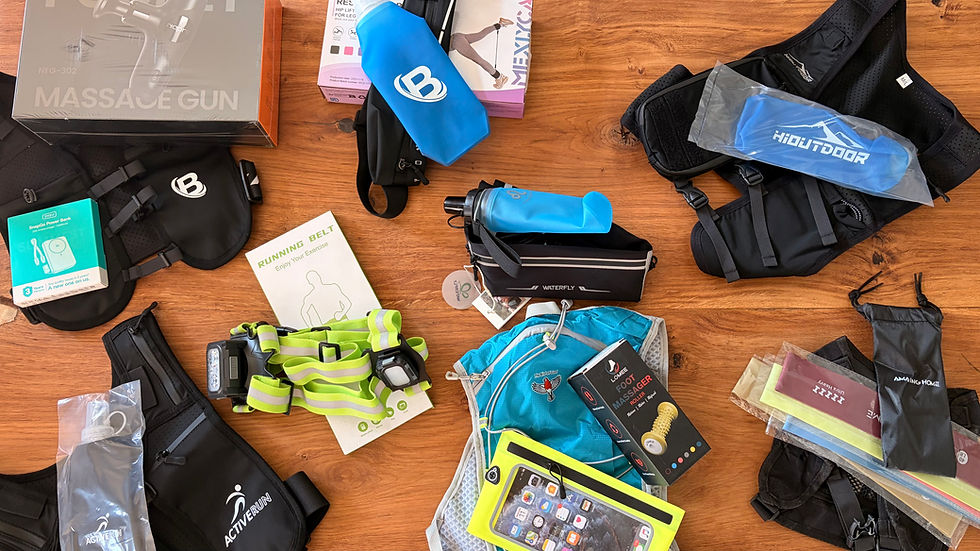
You'll need something to carry your gels. Options include a running belt, an arm sleeve like a Y-Fumble, a lightweight running vest, or the pockets in your kit. Whatever you've been using in training, use on race day.
Hydration
A water bottle is useful pre-race to keep yourself hydrated while you're waiting at the start. On course, there will be water stations. Drink to thirst — if you're thirsty, drink. If you're not, don't force it. If you use electrolyte tablets, carry one in a small bag so you can drop it into a water bottle on course. Electrolytes replace the sodium you lose through sweat and can help stave off cramping, especially if the weather turns warm.
Before the Start: Warm-Up Layers and Logistics
Plan your travel. Know how you're getting there, what time you need to leave, and build in extra time. Things take longer than usual on race morning — parking, public transport, queues for toilets. Give yourself plenty of breathing room.
Warm-up layers are a must. You could be standing around for an hour or more before your start. Wear older clothes over the top of your race kit — a hoodie, joggers, whatever you're happy to part with. These get donated to charity at the start line, so don't bring anything you want back.
Spare safety pins — because someone always needs one.
Toilet paper — the portaloos at the start can run out. A small pack of tissues in your pocket is a simple fix.
Plan for at least one toilet visit, ideally two. The queues at the start can be long, and for first-timers this is one of the biggest sources of race-morning stress. Build toilet time into your arrival plan so you're not rushing.
Your race plan. Your pacing strategy, your fuelling schedule, your cheer point locations. Write it down, screenshot it, stick it somewhere you can glance at. Having a plan takes the guesswork out of the day and gives you something to fall back on when things get tough.
Your Post-Race Bag
After the race, you're going to want:
Warm, comfortable clothes. You'll cool down fast once you stop running. Loose layers, a warm top — whatever feels like a hug.
A recovery snack. Your body is craving carbohydrates and protein. A smoothie, chocolate milk, a sandwich, a banana — anything you can face eating. You might not feel hungry straight away, but try to get something in.
Flip flops or comfortable shoes. If you take your running shoes off after the race, do not try to put them back on. Your feet will have expanded and it won't be pleasant.
A portable phone charger. Your phone has been tracking, playing music and fielding messages for hours. You'll need it to find your supporters and take photos afterwards — don't let a dead battery get in the way.
Wet wipes. For the gels, the sweat, the tears, the snot. You'll want them.
Fresh socks. A tiny luxury that makes a surprising difference.
Mental Preparation: The Bit That Ties It All Together
You can have the perfect kit bag and still fall apart if your head isn't right. Race week is when the doubts creep in — and this is completely normal. It happens to everyone, from first-timers to experienced marathoners. So before you start packing your bag, get your head right first.
Use your training diary. Flick back through the weeks and months of sessions you've done. Those long runs, those tough threshold intervals, those mornings you got out the door when you didn't want to. That's your evidence. That's your confidence. Race week is not the time to worry about what you didn't do — it's the time to absorb everything you did.
Set an A goal and a B goal. Your A goal is the target if everything goes perfectly. Your B goal is what you pivot to if it doesn't. This matters because if your A goal slips away, it's very easy to mentally check out for five or six miles and drift far slower than you're capable of. A B goal keeps you engaged and racing.
Write a mantra. Something personal, something that resonates. It could be as simple as "I can do this" or "One mile at a time." When it gets hard — and it will get hard — having something to repeat to yourself can pull you through those waves of discomfort.
Break the race into small chunks. The marathon is a long way. Your brain likes dealing with small, manageable pieces. 5 km segments, gel to gel, cheer point to cheer point. Each one you tick off gives you a little hit of confidence.
Remember — the discomfort is temporary. It comes and goes in waves. Push through one, and it drops off. Another will come, and you'll push through that one too. Once you get through that tipping point — usually somewhere around miles 22 to 24 — something shifts. Your mind stops trying to get you to stop and starts working out how to get you to the finish. That's when you know you've got this.
The Golden Rule
Nothing new on race day. If you haven't worn it, eaten it or used it in training, race day is not the time to try it out. Everything in your bag should be tested and trusted.
The more prepared you are, the less you'll worry. And the less you worry, the more you can enjoy what is going to be an incredible experience.
Your Checklist, In Your Pocket
We've built this entire checklist — every item mentioned above — into the Full Potential app — a proper, interactive packing list you can tick off as you go. Each item comes with a short explanation of why it matters, so you're not just packing — you're preparing.
No more 3 a.m. panic about whether you packed your gels. No more rummaging through a bag at the start line wondering where your safety pins went. Just open the app, work through the list, and know you've got everything covered.
You've done the training. Now it's time to pack your bag and go show yourself what you're capable of.
Believe. Run. Achieve.